
%201%20(1).png)
Book Now
Start your journey to better health. Select your location below.

Start your journey to better health. Select your location below.
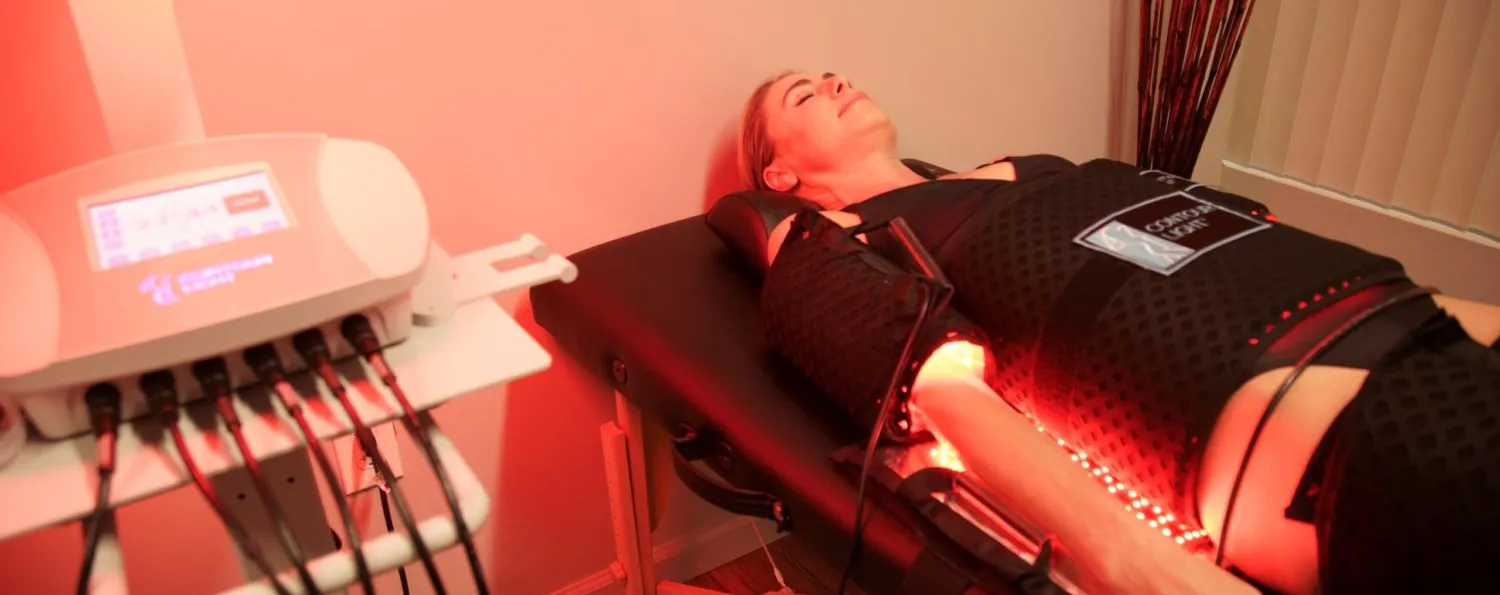
Most articles about red light therapy and weight loss show you dramatic transformation photos and promise you'll drop kilos effortlessly. This one won't. What it will do is explain exactly what red light therapy can and cannot achieve for body composition, what real before-and-after results actually look like when measured clinically, and why the documented 6.3cm circumferential reduction average on a single first Contour Light session is a more useful number than any "after" photo.
If you're evaluating whether red light therapy is the right tool for you, this is the clear-eyed resource you've been looking for.
Important: Red light therapy is one tool among many for body composition. It is not a substitute for a healthy diet, regular exercise, or medical care. The information below is educational. If you have a medical condition or are considering body composition changes for clinical reasons, consult your GP first.
This post is for you if:
- You've seen red light therapy marketed for fat loss and want to know what the science actually supports
- You're exploring non-invasive body composition options beyond diet and exercise
- You want to understand what a clinical "before and after" measurement looks like, not what a promotional photo looks like
When most people search for "red light therapy weight loss before and after", they're imagining a photo comparison showing a slimmer silhouette. That framing matters, because what red light therapy actually produces is a clinical measurement result, not a dramatic visual transformation.
The metrics that change with consistent Contour Light red light therapy are:
Circumferential reduction - This is the primary and most reliable outcome. Circumference is measured in centimetres around the waist, hips, thighs, or arms before and after each session. The documented average reduction on the first session of Contour Light is 6.3cm, matching Contour Light's published clinical data (the manufacturer cites approximately 6.5cm / 2.55 inches in a 25-minute treatment). Observed Beyond Rest client outcomes across 8 to 16 sessions range from 20cm to 150cm total circumferential reduction across treated areas. Individual session-one results vary widely, from 1.5cm to 15cm or more.
Body fat percentage - Measurable using bioelectrical impedance scales, this can shift across a treatment course. A typical improvement is 0.5 to 2 percentage points across 8 to 16 sessions, depending on lifestyle factors.
Visceral fat percentage - The metabolically active fat around internal organs. Some clients see improvement here; outcomes depend on individual metabolism and broader lifestyle support.
Weight on the scale - This is where expectations often need resetting. Red light therapy preserves lean muscle mass while triggering fat cells to release their stored content. The scale may not move much, or at all, while circumference and body fat percentage are genuinely improving. The body is changing composition, not simply losing mass.
A 2011 clinical study by Caruso-Davis et al. documented these outcomes rigorously, finding statistically significant circumferential reductions in participants who received low-level laser therapy body contouring, with no adverse effects reported (Caruso-Davis MK et al., Obes Surg, 2011. DOI: 10.1007/s11695-010-0126-y).
Understanding the mechanism is what separates an informed decision from a leap of faith. Here is what happens at a cellular level during a Contour Light session.
Step 1 - Light absorption
Contour Light reflective-coated pads deliver 635nm red light and 880nm near-infrared light directly to the skin surface. The reflective coating bounces photons back into the skin, so more light reaches the subcutaneous fat layer than with an uncoated panel. The 635nm wavelength is absorbed preferentially by the mitochondria inside adipocytes (fat cells).
Step 2 - Membrane permeability
The absorbed light triggers a temporary increase in fat-cell membrane permeability. This is a natural, reversible process. The cell doesn't rupture or die. It simply becomes temporarily "leaky".
Step 3 - Triglyceride release
The stored triglycerides inside the fat cell pass through the membrane into the surrounding interstitial fluid. This is the literal mechanism behind "fat release into the lymphatic system": the fat hasn't been burned yet; it has been released from storage.
Step 4 - Lymphatic to liver transport
The lymphatic system picks up the released triglycerides and routes them to the liver. The liver processes them via beta-oxidation. If the body is in an appropriate metabolic state (adequate hydration, movement, mild caloric deficit), these lipids are metabolised as energy. If not, they may eventually be re-stored. This is why red light therapy works best as part of a broader lifestyle program rather than as a standalone solution.
Step 5 - Near-infrared support
The 880nm near-infrared component adds circulatory and skin support, improving microcirculation and collagen stimulation in treated areas. This contributes to the skin-texture improvements many clients report alongside circumferential reduction.
A 2013 photobiomodulation review by Avci et al. documented the broad mechanisms by which low-level laser light affects tissue, including adipose tissue, across a range of applications (Avci P et al., Semin Cutan Med Surg, 2013. 32(1):41-52. PMID: 24049929).
One important distinction from other body contouring technologies: Contour Light does not destroy fat cells. Cryolipolysis (CoolSculpting, Clatuu Alpha) destroys cells through cold. Cavitation destroys cells through ultrasonic pressure. Red light therapy works with the cell's own biology. Cells deflate and resume normal function rather than dying. That's why there's no recovery time, no swelling, and no risk of paradoxical adipose hyperplasia (PAH, the rare 0.5-1% cryolipolysis complication where treated fat grows rather than shrinks).
It also means there's no fat-redistribution concern. The cosmetic-surgery literature flags redistribution to non-treated zones as a documented issue with cryolipolysis, since macrophage cleanup routes the destroyed cell contents through systemic circulation. Contour Light's lymphatic-to-liver waste-routing avoids that pathway: triglycerides are processed and either used for energy or excreted, not relocated.
Beyond Rest does not use photography as its primary measurement tool. This is a deliberate clinical decision: photos are subject to lighting, posture, and angle variation that can make the same body look dramatically different without anything actually changing.
Instead, every Contour Light client is measured with:
- Clinical circumference tape (waist, hips, thighs, arms)
- Bioelectrical impedance scales for body fat percentage
- Visceral fat scoring
Every client leaves their first session with an objective, numerical before-and-after result. There is no ambiguity about what changed.
Documented Beyond Rest data:
- Documented average circumferential reduction on session one: 6.3cm (Contour Light's published clinical data shows approximately 6.5cm / 2.55 inches in a 25-minute treatment)
- Individual range on first session: 1.5cm to 15cm or more
- Observed Beyond Rest client outcomes across full 8 to 16 session courses: 20cm to 150cm total circumferential reduction across treated areas
- Sessions run 25 minutes under the Contour Light pads plus 10 minutes on a vibration plate (35 minutes total)
What a treatment course looks like:
Results compound across sessions. A first session typically shows the highest single-session reduction as the treatment targets the most responsive tissue. Subsequent sessions deliver consistent, cumulative improvement. The total course outcome depends on hydration, movement between sessions, food intake and individual body composition.
None of the above is a promise about your individual outcome. The numbers above describe observed averages and ranges, not guaranteed results.
Contour Light is available at five Beyond Rest centres: Hawthorn East, Moonee Ponds, and Prahran in Melbourne, plus East Perth and Wembley in Perth.
One of the most common misconceptions about red light therapy is that a single session produces a "transformation". Here is a realistic, session-by-session picture of what to expect.
Single session
A measurable circumferential reduction, somewhere between 1.5cm and 15cm or more depending on the individual, with a documented average of 6.3cm. Many clients report feeling lighter and seeing a visible difference in the treated area. Energy levels often feel elevated for several hours post-session, likely due to mitochondrial stimulation.
Three to four sessions
A noticeable, consistent shift in the target area. Skin texture often begins to improve. The body is becoming more responsive to the treatment as lymphatic flow increases.
Eight sessions (the 8-pack course)
Body fat percentage measurements begin to show meaningful movement. Circumference improvements often visually apparent to the client and to others. The 8-pack at $1,272 is a common stopping point for clients focused on a single body area.
Sixteen sessions (the 16-pack course)
"Before and after" territory in the clinical sense. Across a full 16-session course with lifestyle support, observed Beyond Rest client outcomes range from 20cm to 150cm total circumferential reduction across treated areas, plus improved body fat and visceral fat scores. The 16-pack at $2,064 is the best per-session value and the standard course for multi-area contouring goals.
What not to expect at any stage:
- Dramatic weight loss on the scale without accompanying diet or exercise changes
- Permanent results in the absence of lifestyle support
- The same outcome as surgical or destructive fat removal procedures
- Results without adequate hydration: the lymphatic system needs water to process released lipids effectively
People evaluating red light therapy are often comparing it to several other approaches. Here is an honest side-by-side.
Red light therapy vs CoolSculpting (cryolipolysis)
CoolSculpting destroys fat cells by freezing them. Macrophages then phagocytose the dead cells and route contents through systemic circulation, with the cosmetic-surgery literature flagging redistribution to non-treated zones as a documented concern. Red light therapy works with existing fat cells, triggering release through the lymphatic-liver route rather than cell death. CoolSculpting can produce more aggressive local reduction in a single treatment area. Red light therapy has no downtime, no PAH risk (the 0.5-1% paradoxical adipose hyperplasia complication where treated fat grows), and can treat multiple areas simultaneously. Different tools, different fat-clearance routes, different side-effect profiles.
Red light therapy vs Clatuu Alpha
Clatuu Alpha is dual-applicator cryolipolysis. Two zones treated at once. Faster session times. Same mechanism as CoolSculpting (cell death plus macrophage cleanup), same redistribution concerns.
Red light therapy vs HIFU (focused ultrasound)
HIFU thermally destroys fat cells at 4.5mm depth. Realistic outcome: 2-4cm reduction across a 3-6 session course. Plateaus after 3-4 sessions. Total cost typically $3,000-$10,000 for a course. Best for small focused areas.
Red light therapy vs RF (radiofrequency)
RF tightens skin through thermal collagen stimulation with modest secondary fat reduction (1-2cm per area across 6-10 sessions). Best framing: skin-tightening modality with fat-reduction byproduct. If your primary goal is firmness, RF fits. If your primary goal is circumferential reduction, RF will frustrate you.
Red light therapy vs liposuction
Liposuction is surgical, with anaesthesia, recovery time, and clinical risk. Red light therapy is non-invasive. Liposuction studies show similar redistribution patterns to cryolipolysis. Clients weighing up the two are often looking for a non-surgical path.
Red light therapy vs ultrasonic cavitation
Cavitation uses sound waves to disrupt fat cell walls. Red light therapy uses photobiomodulation to increase membrane permeability. Both are non-invasive. Cavitation destroys cells; red light releases content through the lymphatic-liver route. Red light carries a lower risk profile.
Red light therapy vs GLP-1 medications (Ozempic, Wegovy)
GLP-1 medications work systemically: they affect appetite regulation and metabolic signalling across the entire body. Red light therapy is local: it affects specific treatment areas. Entirely different mechanisms. GLP-1 medications work for many people and carry their own cost, side-effect, and access considerations. Red light therapy is not a replacement for GLP-1 medications, but it can complement a broader body composition program for people already using them.
Red light therapy vs diet and exercise
Diet and exercise are foundational. Red light therapy is supplemental. The honest reason red light therapy works best as part of a program rather than as a standalone approach: the people who see the best results at Beyond Rest are those using Contour Light sessions alongside improved nutrition and movement, not instead of them.
Contour Light is available at five Beyond Rest locations:
Melbourne
Beyond Rest Hawthorn East - 2/96 Camberwell Rd, Hawthorn East
Beyond Rest Moonee Ponds - 14 Hinkins St, Moonee Ponds
Beyond Rest Prahran - 26 Regent St, Prahran
Perth
Beyond Rest East Perth - 125 Edward St, East Perth
Beyond Rest Wembley - 1/252 Cambridge St, Wembley
Note for Melbourne readers: the Beyond Rest Collingwood centre does not have Contour Light. Collingwood offers contrast therapy (sauna and ice bath). For Contour Light in Melbourne, the closest locations are Hawthorn East (8 min from Collingwood) and Prahran.
Pricing:
Every first session includes before-and-after measurements so you leave with objective data on what changed.
For full details on the Contour Light program and to book, visit Beyond Rest Contour Light, Body Contouring Perth, or Body Contouring Melbourne.
Red light therapy is not appropriate for everyone in all circumstances. The following situations warrant a conversation with your GP before proceeding:
These are genuine clinical considerations. If you're unsure whether Contour Light is appropriate for your circumstances, the team at any Beyond Rest centre can talk through the intake criteria with you before you commit to a session.
The most useful thing about Contour Light is that it removes the guesswork from the "does red light therapy actually work?" question. You don't have to trust a before-and-after photo or a manufacturer claim. You measure before. You do the session. You measure after. You have a number.
For many clients, that first-session result, a specific centimetre reading on a tape measure, is more persuasive than any amount of testimonial content. It's the kind of result that turns a one-session trial into a consistent treatment course.
Book your first Contour Light session at $119 (normally $245, 35 minutes total: 25 minutes under the lights plus 10 minutes on the vibration plate) at Beyond Rest Hawthorn East, Moonee Ponds, Prahran, East Perth, or Wembley. Every first session includes before-and-after measurements (circumferential, body fat percentage, visceral fat) so you leave with a specific number, not a promise. Book online at beyondrest.com.au or call your nearest Contour Light centre.
For the full picture on how Contour Light works, the research behind it, and what to expect across a complete program, visit Beyond Rest Contour Light.
Red light therapy produces measurable circumferential reduction and can improve body fat percentage over a treatment course. Weight on the scale may not change significantly, because the treatment preserves muscle mass while triggering fat cells to release stored triglycerides. The more accurate description is "body composition change" rather than "weight loss" in the conventional sense.
The documented average on the first Contour Light session is 6.3cm. Individual session-one range is 1.5cm to 15cm or more. Results vary based on individual physiology, hydration, and session preparation. Every client is measured before and after each session, so there's no ambiguity about what changed.
You'll see a measured result in your first session. The question is how significant and how sustained that result will be over time. A typical treatment course is 8 to 16 sessions for meaningful, lasting body composition improvement. Single sessions are available if you want to test before committing to a course. Observed Beyond Rest course outcomes range from 20cm to 150cm total circumferential reduction across 8-16 sessions.
Contour Light is FDA-cleared for body contouring. It's non-invasive, does not destroy fat cells, and carries no downtime. Not appropriate in some circumstances such as pregnancy, photosensitive medications, or active infection. The Beyond Rest intake process screens for these. If you have a specific medical condition, speak to your GP before booking.
CoolSculpting destroys fat cells through cold and relies on macrophage cleanup, with documented fat-redistribution concerns to non-treated areas and a 0.5-1% PAH risk. Contour Light works with existing fat cells through membrane permeability and routes triglycerides via lymphatic to liver for processing. No downtime, no PAH risk, no redistribution concern. Different mechanisms, different fat-clearance routes. Full breakdown: Contour Light vs CoolSculpting vs Cryolipolysis.
Contour Light is at five Beyond Rest centres: Hawthorn East, Moonee Ponds, and Prahran in Melbourne, and East Perth and Wembley in Perth. Not available at the Collingwood centre, which offers contrast therapy instead. Book at beyondrest.com.au or via the links in this post.
Hydration is the most important preparation factor. The lymphatic system needs adequate water to route triglycerides to the liver during and after a session. Beyond Rest recommends arriving well hydrated and continuing to drink water for several hours after. Light movement post-session (even a short walk) also supports lymphatic circulation.
Results are sustained with lifestyle support. Red light therapy does not permanently remove fat cells (unlike liposuction or cryolipolysis). If lifestyle factors that contributed to fat accumulation continue unchanged, fat may eventually be re-stored. Clients who pair Contour Light sessions with improved nutrition, adequate sleep, and regular movement see the most durable long-term outcomes.